The question was small. Your reaction wasn't.
A cup left on the side. Someone pulling out in front of you. Your partner asking whether you've paid the bill. Nothing that should have turned the room cold.
But your jaw locked. Your voice climbed. And once again, the people you love got the version of you that everyone else was spared.
Afterwards comes the familiar excuse: I'm just stressed.
Maybe. But stressed about what? And why does a minor inconvenience feel like a declaration of war?
What's under the short fuse?
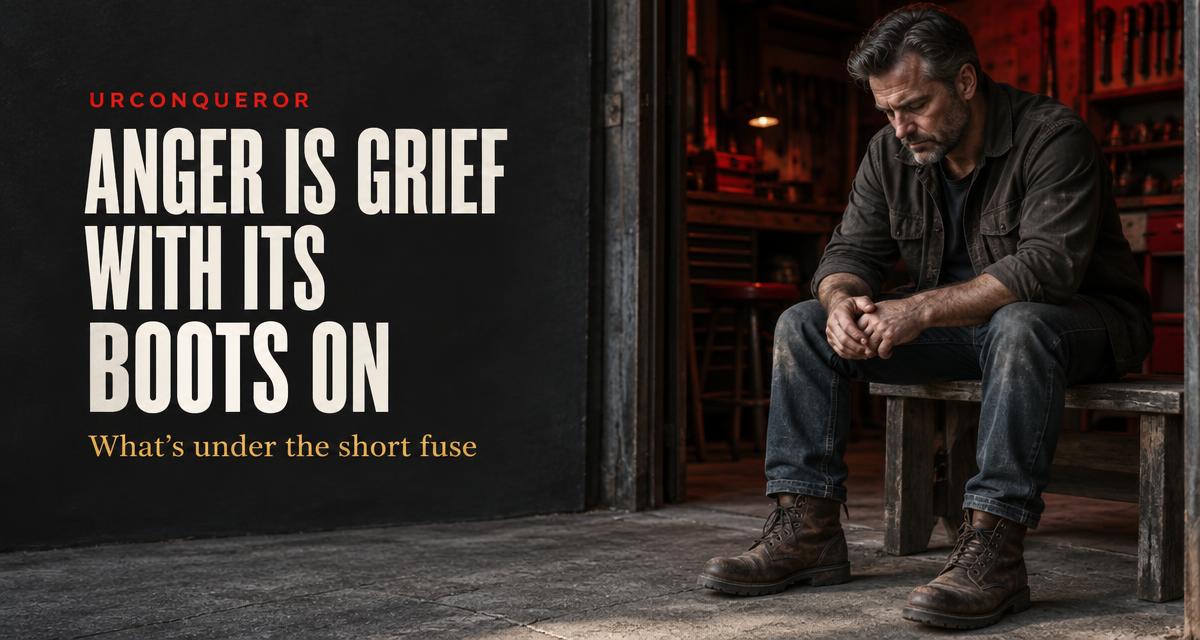
Sometimes, anger is grief with its boots on.
Grief sits down and admits something hurts. Anger stands up and finds somebody to blame. One feels exposed. The other feels armed.
For a man taught to swallow sadness, anger can become the emotion that feels permitted. You don't say, I feel forgotten. You say, Nobody listens around here. You don't say, I'm frightened I'm failing. You snap at the person who asks how work is going.
It might be grief for a father you never properly mourned. A relationship that changed. The body you used to trust. The life you expected to have by now.
Or the quieter loss: years of being useful to everyone while feeling known by no one.
The anger is real. It may not be the whole truth.
Not every angry moment hides grief. Anger can signal injustice, an unmet boundary, fear, exhaustion or overload. This title is a lens, not a diagnosis. The useful question is not whether it explains every man. It's whether it explains something in you.
Understanding anger doesn't excuse what you do with it
Anger isn't automatically bad. It can tell you something needs to change. It can give you the energy to protect a boundary or challenge unfairness.
But there's a difference between having a feeling and handing it the keys.
Your pain doesn't give you permission to frighten your partner. Your workload doesn't make your children responsible for your temper. Slamming doors, humiliating people and calling it honesty isn't strength.
You can be hurting and still be accountable.
Controlling emotions doesn't mean becoming a stone. It means noticing what you feel before it becomes something somebody else has to survive.
How to control anger when the heat rises
Don't wait until you're shouting to look for self-control. Learn your early warnings: tight shoulders, clenched fists, faster breathing, the sudden certainty that you must win this conversation.
That's your signal to interrupt the pattern.
- Stop adding fuel. Don't send the message. Don't follow someone into the next room to finish your point. Put down what you're holding and give the moment some space.
- Take a safe pause. Say, “I'm getting worked up. I need a pause, and I'll come back to this.” Agree when to return if you can. A pause is not punishment or disappearing for days.
- Let your body settle. Breathe gently, without forcing deep breaths or holding your breath. Feel your feet on the floor. If focusing on breathing makes you more uncomfortable, look around and name five things you can see instead.
- Name the feeling beneath the accusation. Try “I'm hurt,” “I'm scared,” or “I feel overlooked.” Start with what you actually know about yourself, not what you assume about them.
- Return with one clear request. “Can we talk without interrupting?” works better than “You never respect me.” Address the problem. Don't put the person's entire character on trial.
You won't do this perfectly. The point is to create enough room for a choice.
And if you've already crossed the line, repair it without a little defence hidden inside the apology. “I raised my voice. That wasn't acceptable. I'm sorry. Here's what I'm changing.” Not “I'm sorry, but you wound me up.”
Mindfulness for men: no incense required
Mindfulness isn't emptying your head. It isn't smiling politely while life kicks you in the teeth.
It's paying attention to the present moment: your body, your thoughts, your feelings. Noticing them without immediately obeying them or attacking yourself for having them.
Think of it as learning to hear the engine before it overheats.
For beginners, start with two minutes on an ordinary day, not in the middle of your worst argument.
- Sit or stand comfortably. Keep your eyes open if that feels better.
- Notice your feet touching the floor and the sounds around you.
- Notice your breathing as it is. No special performance.
- When a thought arrives, quietly label it: “planning,” “worrying,” “remembering.” Then bring attention back.
- Ask: “What am I feeling? What do I need? What is one responsible action I can take?”
Your mind will wander. That's not failure. Noticing and returning is the practice.
Try it before opening your phone in the morning, or before walking through the front door after work. Let the people inside meet you, not the entire day you've dragged home.
Mindfulness may help. It isn't a guaranteed cure, and it doesn't suit everyone. If inward attention brings distress, stop and use an external anchor, such as a sound or an object. Seek professional guidance if you need it.
Find the loss. Change the pattern.
When you're calm, write three lines: What happened? What did I tell myself it meant? What actually hurt?
“She asked about money” is the event. “She thinks I'm useless” is your interpretation. “I'm frightened about letting everyone down” might be the hurt.
Those are three different things. Treating them as one is how a question becomes a fight.
Look at the practical fuel too. Poor sleep. Too much alcohol. No movement. A week without an honest conversation. Emotional work doesn't replace looking after your body or changing an unreasonable situation.
If grief keeps appearing, give it somewhere to go: a trusted friend, a counsellor, a conversation you've been avoiding. You don't need to earn the right to ask for help by falling apart first.
Your next move: assessment, Zhi or the free lessons
The Continuum of Man is about self-leadership across Mind, Spirit and Body. That includes the man you become when you're tired, disappointed and nobody is applauding.
Take the free Continuum Assessment to reflect on where you stand and choose a starting point. It isn't a clinical assessment of anger or mental health.
Want somewhere to start an honest conversation? Talk to Zhi, our AI mentor. Try: “I keep snapping at the people I love. Help me examine the trigger, the story I'm telling myself, and a calmer next step.” Zhi can support reflection. He isn't a therapist, an emergency service or a substitute for professional care.
Prefer a structured beginning? Get Modules 1 & 2 Free from The Continuum of Man: Complete. The course page explains your next step; free lessons and course access are hosted on Azuni World.
Know when this needs more than a blog
If anger keeps damaging your relationships, feels uncontrollable, or involves threats, violence or abuse, seek professional support. Speak to your GP or a qualified local professional. Your family's safety comes before protecting your pride.
If you think you may hurt yourself or someone else, stop the confrontation and seek urgent help. In immediate danger, call 999 in the UK or your local emergency number elsewhere.
You don't have to stop feeling anger.
You have to stop letting it speak for everything you haven't faced.
Take the boots off. Find out what hurts. Then decide what kind of man handles it.
Further reading: NHS guidance on anger and Mind's guidance on managing anger. This article offers general reflection and self-help, not medical advice.